Showing posts with label nymphalids. Show all posts

Wednesday, December 25, 2013

Brown King Crow

Merry Christmas to all readers and I hope you all are having the best of the season. The Forty first butterfly in the 'Butterfly from my garden' series is the 'Brown King Crow' ( Euploea klugii )


This is also the 300th post on this blog. The first post was on 10th Nov. 2006 and it has been 7 years, 1 month and 15 days since I began blogging here. Just like the title of the first post 'Snails pace' the 300 posts indeed have come at a snails pace. 
This butterfly visits us at noon and stays till the the evening. Loves the marigold flowers and stays quite steadily perched on flowers even in heavy winds. I will not take too much of your Christmas time with today's post. Have a lovely day.

Monday, December 23, 2013

Common Palmfly

The fortieth butterfly in the 'butterfly from my garden' series is the Common Palmfly ( Elymnias hypermnestra ). I see this butterfly everyday perched on the ornamental palms of our garden. This photograph though was clicked when it landed inside our house one day. 


The only time I see its uppersides are when it is in flight, else it always sits with its wings folded. The female mimics the striped tiger. This butterfly belongs to the Nymphalids family ( remember from previous post, that there are five major butterfly families). The Nymphalids is a large group and occurs in almost all shapes and colours. Males of this family are pretty quarrelsome and can be seen policing their territory. The first pair of legs in these butterflies have brush-like dense tufts, but being imperfectly developed and clawless, these legs are not used for perching and walking. This family also has many sub-families and like the males of these family, the taxonomists themselves keep quarreling about the exact status of these sub-families. 

Sunday, December 15, 2013

Common Leopard.

When I decided to take a photographic butterfly census of my garden, never in my wildest dreams had I imagined to count so many butterflies. I was expecting about fifteen species and the tally today is thirty six.
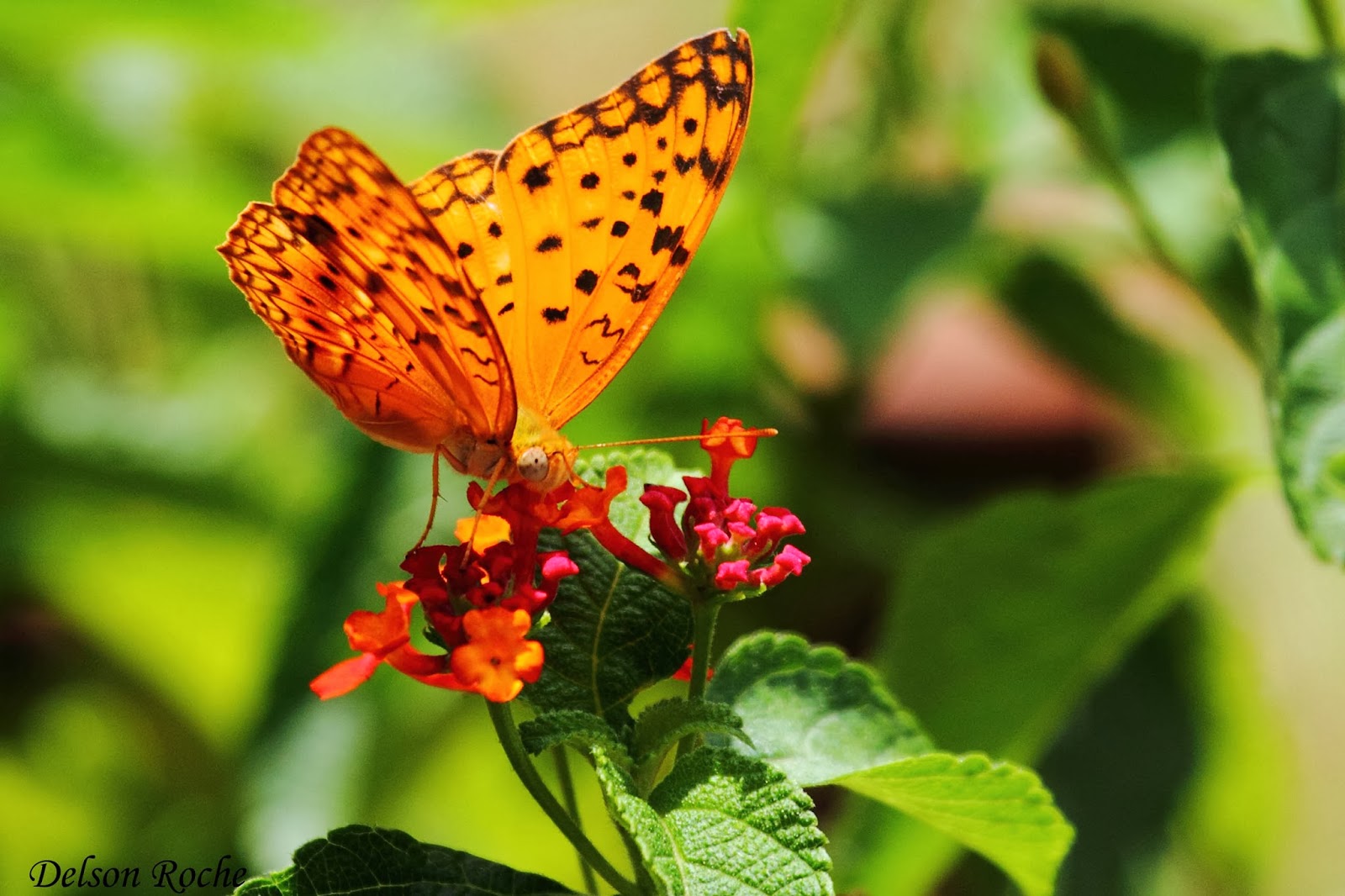
Today's Special is Common Leopard ( Phalanta phalantha ) .


Not only do the mammals have a leopard and a tiger, the butterflies their's too.


This is a common Indian restless butterfly, which is territorial and pugnacious . Flies very swiftly and found of flowers. This was one of the easiest photograph to click. I was sitting out in the porch, with my beloved, when she noticed an "orange butterfly". Another one for the count she said. Fortunately my camera was besides me. Without moving an inch on my butt, I managed to get this lovely flying beauty.

Monday, December 9, 2013

Grey Pansy

After all the confusion with the Bushbrowns, it is time to move back into some stable ground. The thirtythird, butterfly in the series- "Butterflies from my Garden" is the Grey Pansy ( Junonia atlites )


It visits us at noon,after 1PM. The butterfly is common in areas of heavy rainfall. It prefers areas around freshwater marshes and paddy fields. Keeps a large distance from people and quite alert to any disturbances around.   

Saturday, December 7, 2013

Dark Branded Bushbrown

Another Bushbrown to add to all the confusion among bushbrowns. The third Bushbrown featured today is probably the Dark-Branded Bushbrown (Mycalesis mineus).

 With varying forms, with changing seasons, the bushbrowns are not identity friendly to me atleast.  So as I type this post, thoughts are running in my mind, whether to post this as a Dark Branded Bushbrown or to just keep quite, taking cue from Peter Smetacek, who wrote me "... but one really needs the specimens to open one's mouth further... ". Nevertheless, sharing it with you. 

Thursday, December 5, 2013

Long-Brand Bushbrown

This is allegedly a Long-Brand Bushbrown ( Mycalesis visala). You can read my previous post to know why I say 'allegedly'.

All this confusion about bushbrown species makes photographing butterflies much more action packed. I cannot take it for granted that I have already photographed a particular species, it just may turn out to be a new one all together.

Tuesday, December 3, 2013

Common Bushbrown

The thirtieth species from my garden is the Common Bushbrown, ( Mycalesis perseus )


We have many of these hanging around the bamboo grove and the compost pit. They are easily recognisable as a group, all being some shade of brown on both wing surfaces, and marked with a series of conspicuous ocelli, and a single straight median line across the underside of both wings.
The difficult part is to identify the exact species. I was so flummoxed by this problem, that I decided to write to the person who inspired the series in the first place- Peter Smetacek himself.
The genial Peter, got back to me immediately and wrote " ...I usually do not put names to these. They need to be dissected for certain identification. In the case of the bushbrown, one needs to see the brands (areas of specialized scales) between the forewing and hindwing, in the region of overlap.... "


This fact only reinforced what I knew, photographs alone cannot be an infallible taxonomy tool; the good 'ol running behind and catching a butterfly too counts. 

Wednesday, November 27, 2013

Common Four-ring

The twenty seventh butterfly in the series is the Common Four-ring ( Ypthima huebneri ).


Since I started this photographic census of the butterflies of our garden, my wife, Aarina, too has been quite interested in learning the names of butterflies. Infact most of the butterflies in this series were identified by her, while I was editing the images ( which does not take more than 2-3 minutes).


A few months ago, butterflies were identified by their colour at home; "Oh! thats a blue butterfly" "Wow! such a pretty orange butterfly". Today the lines are, "there goes a glassy tiger ". "Oh is that a Striped tiger or a plain tiger on the Ixora bush" This butterfly count has been such a rewarding and learning experience for all of us.

Tuesday, November 19, 2013

Common Sailer

The twenty third butterfly in the series is the Common sailer ( Neptis hylas ).
Honestly, this is a very rare visitor to our garden. In about 2 weeks spent photographing butterflies, I have seen this sailer twice or thrice.


It has a graceful sailing flight and enjoys rising up in the air with the thermals.
Hylas was the son of King Theiodamas of the Dryopians.Hylas was kidnapped by nymphs of the spring of Pegae, that fell in love with him and vanished without a trace
Both these photographs were clicked with a telephoto lens on a tripod. Even the compound eyes are clearly visible in the photograph.

Sunday, November 17, 2013

Plain Tiger

In the previous post, I had featured a striped tiger. Now you steal those stripes, you get a Plain Tiger (Danaus chrysippus ).


For reasons mentioned before, this butterfly too is mimicked by many butterflies like the Leopard Lacewing, Tamil Lacewing, female Indian Fritillary, and female Danaid eggfly. Just like the Striped Tiger, the male of the Plain tiger too has pouch containing scent scales.
The butterfly is named after Chrysippus, the Greek Stioc Philosopher, who created an original system of propositional logic in order to better understand the workings of the universe and role of humanity within it.

Friday, November 15, 2013

Striped Tiger

Not only the mammals have a tiger, the butterflies too have their own tigers. Today's butterfly, the Striped Tiger ( Danaus genutia ) is dreaded by birds.


Its body contains the toxins of the plants, it consumed as a caterpillar. Any bird trying to eat it, will have an experience of  life time and its bright orange colour more than amply advertises this fact.
A pretty common butterfly in our garden. The male has a small pouch on the hindwing ( oval shaped) that carries scent. When attacked it fakes death and oozes nauseating liquid which makes it smell and taste terrible. It has the ability to recover soon after an attack.

Saturday, November 9, 2013

Bamboo Treebrown

Just like the name suggests, I found this Bamboo Treebrown ( Lethe europa ) perched on a bamboo stalk. 


This butterfly is often seen in our bamboo grove, usually during a rainy day. I had to brave quite few red ants, which have built a nest for themselves, to get close to this butterfly. I have also seen this butterfly feeding on rotten fruits from our compost pit and also reportedly loves crabs. This now becomes the eighteenth butterfly spotted in out garden (within this month).


Thursday, November 7, 2013

Danaid Eggfly

The seventeenth species in the 'butterfly from my garden' series is the Danaid Eggfly ( Hypolimnas misippus) The below photographs are of the female, which mimic the Plain Tiger ( remember my previous post on the reason for mimicry) 


The below photographs are of the male.

The male of the butterfly is quite similar to the Great eggfly ( featured a few days ago) and can sometimes be quite a challenge in the field to discern.
If the male is sitting on bare ground like this- it is probably soaking in minerals from urine of animals or humans.

So why is an eggfly called an eggfly? Several member of this genus are extraordinary parents, compared to other butterflies. They safeguard their offspring with a lot of care. Prior to laying eggs they ensure that they are clear from any predators, especially ants. Once they lay their eggs, they stand guard over them, like a protective umbrella protecting them from wasps. They stay this way, until the eggs are hatched and the caterpillars have dispersed.  Meanwhile the protective female dies in this position. This butterfly is also infected by a bacteria called Wolbachia, which kills only the males.

Sunday, November 3, 2013

Peacock Pansy

When I started this series of "Butterflies from my garden" I was hoping to at least photograph fifteen butterfly species. I have now crossed my initial estimate and this Peacock Pansy ( Junonia almana ) is the sixteenth in the series.
This is a common garden visitor, who maintains a very large distance from me and my tripod. Hence all photographs of this butterfly are clicked for a great distance. This species thrives on the plant Hygrophila auriculata, which is also used extensively in Ayurvedic medicine.

The butterfly as visible, is orange with prominent eyespots- now the question we may ask is; why do butterflies have eyespots ( many of which even looks like eyes)? I have come across two interesting but contrasting theories. One believes, that the eyespots act as target for the predators and their attack is deflected towards the eyespot instead of some vital part of the body. Losing bit of wing edges does not adversely affect the butterfly. Another theory states that predators don't attack from the front, they prefer to sneak from behind and catch their prey. So for a predator, the eyespots give the wing the appearance of a face and will attack the butterfly from its real front ( imagining it to be the back side). This will give the butterfly ample warning time, to fly off. You can accept either of the ideas or any one that you feel suits the best.


Thursday, October 31, 2013

Great Eggfly

The Great Eggfly (Hypolimnas bolina ) is a common Indian butterfly which loves living in forests, but does not mind visiting that occasional garden. 


Males of the Great eggfly are supposedly territorial and pugnacious. The above photograph is of the upperside of a male while the lower one is of the underside. Like many other butterflies this one too has subdued underside and brighter upper sides (the ovals are iridescent blue); butterflies have this for a reason.


When the wings are folded together at rest, the subdued colours provide a camouflage. When disturbed, they open their wings and fly off, flashing their brilliant upperwing colour that momentarily startles the predator. This also gives the butterfly an opportunity to fly away and disappear among dried foliage, leaving the predator to search for a colourful butterfly.


The below are the photographs of the Female, which is a excellent mimic of the Crow butterflies ( see my previous post, to know all about mimicry)


Tuesday, October 29, 2013

Grey Count

Another royal visitor to our garden, the Grey Count ( Tanaecia lepidea ). It's not very frequently found in south India and I was quite lucky to have found it perched among banana leaves. 


It was quite dark, and I had to use the on camera flash to illuminate it, despite using a 400 mm lens. The flash barely illuminated the butterfly, but was at least enough for a steady hand held shot.
The royal butterfly had a graceful poise and flight. I see it spending most of its time in the dark confines of the banana trees. Hoping for some more royals in the coming days.

Sunday, October 27, 2013

Glassy Tiger

The thirteenth butterfly in the 'Butterflies from my garden' series is the Glassy Tiger (Parantica aglea ).


This is quite a common butterfly in India, and it is mimicked by many other butterflies like the Tiger Brown, Courtesan male, Siren, Great Blackvein and female of the Common Wanderer. So why do the butterflies have this mimicry? This was nicely explained by Peter Smetacek in his book "Butterflies on the roof of the world" but to summarise ; Certain butterflies during their caterpillar stage feed on plant poisons, which are then stored in their bodies. During its adult stage this distastefulness is advertised by bright warning colours and patterns. Predators who catch and eat such butterflies experience a lot of unpleasantness like strong heartbeat and vomiting. The predator learns to stay away from such butterflies.


Some butterflies cannot digest and store the plant poisons, so these butterflies mimic the patterns of the distasteful species and survive on their reputation. They even have flight patterns that mimic these butterflies. The glassy tiger had acquired the toxins from the milkweed plant during its caterpillar days, hence its distasteful. Hence so many other species mentioned above imitate it.

Friday, October 25, 2013

Common Baron

Two butterflies that visit our garden are named after royal positions, but they mostly spend their time in our compost pit, and seem to enjoy the rotting garbage. One is featured today, the Common Baron ( Euthalia aconthea)

 The above and below photographs are of the female Common Baron and the last one is a male. The male resembles Chocolate Pansy featured a few post ago.


The Common Baron, loves places where crops are grown, enjoys basking in the sun and also our compost pit. 

The above photograph is of a male which is smaller than the female. Some  royals like the Common Nawab and the Tawny Rajah are enticed by rotting crabs and prawns. Lepidopterist's do have a sense of humour. 

Wednesday, October 23, 2013

Common Evening Brown

Butterflies come with all kinds of quirks, some love a good hot sunbath, while some like these Common Evening Brown ( Melanitis leda ) love some darkness in their live's.  


This butterfly is active at dusk, and I have seen it come home attracted to the light at night. They spend their day in the undergrowth and in our garden they prefer the bamboo grove. This was photographed there, at about noon, with the overcast sky providing a nice diffused sunlight. They seem to prefer overripe fruits or tree sap and I have yet to spot one perched on flowers.

Friday, October 11, 2013

Rustic

I saw this butterfly only once during the two weeks that I have spent photographing the garden butterflies. Nevertheless, since it landed and spent a few minutes on one of our plants, I will add it to the count. 

Aptly called Rustic (Cupha erymanthis), probably because of its colour, this is a common Indian butterfly. It prefers places with heavy rainfall and is quite restless. I see it spend a lot of time on the trees of our neighbours and spotted between 10 AM to about 1PM. Not sure where does it disappear after that. Male is quite territorial and are found of flowers.